Monday, February 3, 2014

A Work Day

It's Monday morning and a work day beckons:
     Preparing basket kits for teaching
     Writing 3 weaving patterns
     Working on my book
     Finishing a basket for the gallery
     Writing proposals to apply for teaching

What is NOT included in my day:
     Traffic to get to work
     Noise and fumes
     Working for someone else
     Views of congested roadways and city streets
     Getting dressed up and wearing make-up
     Tension and stress

I definitely don't take my life for granted.  Even with a full day of work ahead, I appreciate the idyllic views of Barlow Bay, taking a break to refill the bird feeder, planning a walk after lunch to breathe the island air, and occasionally petting or playing with my feline assistant.  I know, I've worked hard to create this life. But I am continually grateful for what I have.  Perhaps the word I'm looking for might be....happy??

Sunday, February 2, 2014

Slower & Simpler - All Those Books

One area of my life that definitely needs attention is my horde of books.  I'm ready to clear out my accumulation from the years...except for all of my basketry, beading, and craft books.  That will require additional enlightenment, I'm afraid.

Mike Burns has a great blog on why we keep our books:

4 Faulty Reasons That We Keep Too Many Books

4 reasons too many booksBooks are hard to get rid of.
There’s something about them that makes it hard to say “goodbye.”
It may be the smell of the pages or the texture of the cover. It may be the memory of how much the information inside them changed our lives for good. Perhaps there’s a sentiment attached because of our feelings toward the person who gave it to us.
There are lots of reasons why we want to hold on to our books. But, for many people, book clutter is a significant problem.
I often hear people talking about how difficult it is for them to declutter their bookshelves (and the boxes of books in their garages!)
I can relate.
I love to read.
Over the years, I accumulated MOUNDS of books. Some I read, some I skimmed, and others I stored away, waiting for some “extra time” to pull them out and dig in.
Until it just got plain ridiculous.
We’ve moved a number of times over the past 15 years. We enjoy it. But, what we did NOT enjoy, was dragging around totes and boxes of books that felt like they weighed 3 tons each!
The pain of keeping them became great enough to move us to action. So, I began getting rid of some books…a little at a time.
I did this a number of times, until finally, I committed to drastic measures when we moved across the country with just a small 6×12 UHaul trailer. At that point, I whittled what was left of my huge book collection down to only 18 physical books.
I learned some things throughout that process. I learned a little bit about myself and why I, personally, held on to so many books. I’m going to share a few of the reasons with you, in hopes that you may resonate with them.
If we can identify our resistance points, then we can work against them and make clearer decisions.
Obviously, there is no magic number of books that each person should own. In fact, if owning 3,000 books makes you happy and doesn’t interfere with your priorities, GO FOR IT! There are no simplicity police that will come and knock on your door. It’s your life, and you have the right to have your own library if you choose to do so!
But, for those of us who are frustrated by the piles of books and want to do something about it…. I remind you that “You CAN do this!” You can identify your faulty reasons for keeping them, remind yourself why they’re faulty, and declutter your collection.
Here are a few of the things you may be telling yourself.

4 Faulty Reasons That We Keep Too Many Books:

“I’m going to read them again, soon.”

Be honest. You probably won’t. You want to, but your time restraints and appetite for NEW books will likely drown those intentions. There may be a few that you actually WILL read again. If so, keep them. But few is the key word. If you haven’t read them by now, it’s not likely that it’s going to happen.

“My children will read them one day.”

Maybe. But probably not. There are a few books that are “timeless.” But most are very time- and culturally-specific. There are so many books being written every day and that is not likely going to change.

“I don’t want them to go to waste.”

This is totally understandable! But, there’s good news… They don’t have to go to waste! You can pass them on to other people in a number of different ways (by selling or donating them). Just because you are finished with them doesn’t mean that their work is done!

“I might need to reference them in the future.”

This was more of a legitimate concern before the internet. Today, it doesn’t carry much weight. As long as we have online access, we can find whatever little piece of info we need in a matter of seconds. And, I’m fairly certain that online connectivity isn’t going anywhere.
These are just a few. You may have your own faulty reasons that aren’t on this list. Whatever they are, face them. Call them what they are.
Don’t forget…I’m an author. I’m not trying to do away with physical books. I love them! I hope people keep buying them.
But too much is too much. At some point, they have to move on. There are others who could benefit from them. I’ll keep a few that I really love. But I won’t keep them all.
How about you?
Do you have too many books?
What faulty reasoning has held you back from decluttering your collection?
http://theothersideofcomplexity.com/4-faulty-reasons-that-we-keep-too-many-books/?utm_source=The+Other+Side+of+Complexity+-+Blog+Updates&utm_campaign=5dcd6eea83-RSS_EMAIL_CAMPAIGN&utm_medium=email&utm_term=0_74c4063970-5dcd6eea83-96885493

Saturday, February 1, 2014

Super Bowl Preparations

While most football fans are preparing for tomorrow's game by organizing parties, planning drink, food and snacks, or calling friends to meet them at the sports bar, my quiet island life might seem very tame.

I used an old gift card to buy a Seahawks t-shirt while on the mainland (in keeping with . I've made sure that I can see the game on my computer (since I don't have television reception on the island).  I have healthy snacks and a freshly brewed pitcher of iced tea planned.

But the most important preparation?  Having projects to work on during the game, such as cutting spokes for basket kits, crocheting, or working on a basket......things that need to be done, but don't require too much concentration, so I can also watch the game.  It's how I've always watched games.  I can't just sit and watch the game....it gets too intense for me.  I need a bit of distraction.

Go Hawks!!

 + +


Friday, January 31, 2014

Dreaming of School


The title of this blog may be a bit misleading.  No, I'm not dreaming about returning to school (at least I don't think so).  I had a disturbing dream last night,  realizing that I hadn't attended any of my classes or opened any of my books (at least it wasn't exam time yet). The feelings from the dream are still very present this morning, so that tells me I need to try to decipher them.

Some interpretations would indicate that I may be a perfectionist and am putting expectations on myself that are too high and I'm fearful of not meeting them. I may be neglecting an important issue in my life or am unprepared for a challenge.  Perhaps I feel that I'm slacking and not giving my best in some area of my life. Some might say it also entails fear of rejection, but I have a hard time relating to that last one.

I do believe that dreams stem from the unconscious mind (although I do acknowledge that they also occasionally result from eating something odd before bedtime) and may reflect anxieties and fears from my waking life.  And while the best way to eliminate or deal with them may be confronting and resolving the basic issues, the problem still remains of figuring out what those issues are!!

If a dream holds this much energy for me, and I can remember it so vividly, I do need to at least attempt an interpretation.....because I'm pretty sure it has nothing to do with Calculus, French, and Western Civilization.


Thursday, January 30, 2014

It's Not Even Sunday


My Sunday posts are the ones dedicated to slower and simpler living.  I know it's not Sunday yet, but yesterday I actually practiced what I preach and it felt wonderful.

As I walked into my office, I passed (as usual) a box and some other miscellaneous stuff on the floor, and noted once again my irritation with the clutter.  I sat down to work, and simply stopped. What was that I used to teach in my seminars?  Oh yeah - start cleaning or decluttering those areas that bother you most.  I stopped what I was doing, and in 10 minutes, had that entire corner of the office cleaned up.  Really?? All the energy I've expended in trying to ignore the mess was corrected in a few minutes???  Why do I forget these simple remedies?

Having worked for awhile, I went to the kitchen to make breakfast. Again, I noted in passing the counter under the microwave and it's accumulated "stuff". And I also realized it was the next most irksome area that needed attention.  Instead of ignoring the problem, since I had had such great success in the office, I took a few minutes in sorting, disposing, and clearing away the mess.  Wow!

Simply clearing away the small areas that are the most irksome is so freeing.  Key word is small area - I'm not ready to tackle an entire room, from the aspect of time and energy.  But every job can be broken down into doable, 10 minute tasks.  And cleaning away what bothers me most has immediate benefits. Having removed the irritation, and feeling successful, I can then go about my day.

Yesterday's Lesson:  Stop ignoring the bothersome areas of my life and take a few minutes, if not daily then at least weekly, to tackle the most irksome.  Really, how hard is that??


Wednesday, January 29, 2014

Sudoku and Beyond


Working on puzzles helps our minds to stay young, aside from just being enjoyable. Some folks do crossword puzzles daily.  I prefer math puzzles. And yes, I do them daily.

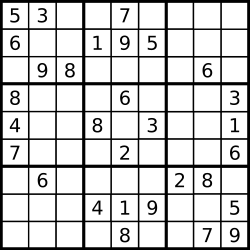
I started years ago doing Sudoku, which I thought originated in Japan, but after some research (of course) it also has roots in France and puzzles by Howard Garns in America.  But we know it as Sudoku, which is the registered trademark in Japan.  Sudoku is a logic based combinatorial number-placement puzzle.


Next I found Ken-Ken, which is the trademarked name for a style of arithmetic and logic puzzle invented by Japanese math teacher Tetsuya Miyamoto who intended the puzzles to be an instruction-free method of training the brain.  Per Wikipedia:  KenKen grids are divided into heavily outlined groups of cells –– often called “cages” –– and the numbers in the cells of each cage must produce a certain “target” number when combined using a specified mathematical operation (either addition, subtraction, multiplication or division).
So Ken-Ken takes Sudoku a step further by including math operations.  (This one is also my personal favorite, at the moment.)


Then there is Kakuro, also from Japan.  Again from Wikipedia:   is a kind of logic puzzle that is often referred to as a mathematical transliteration of the crosswordThe objective of the puzzle is to insert a digit from 1 to 9 inclusive into each white cell such that the sum of the numbers in each entry matches the clue associated with it and that no digit is duplicated in any entry. It is that lack of duplication that makes creating Kakuro puzzles with unique solutions possible, and which means solving a Kakuro puzzle involves investigating combinations more, compared to Sudoku in which the focus is on permutations.


Of course there's always just the basic logic problems to solve.


No judgment, please. This is just how my mind works.  Doing these puzzles is my way to relax while getting my mind in gear. And yes, I actually really enjoy them!!

Tuesday, January 28, 2014

A Perfect Cup of Tea

In an earlier post (last January, I believe), I talked about being a tea snob.  Well, it hasn't gotten any better, I'm afraid.  In that post, I wrote about using hot water, just before it boils or just as it starts to boil.  Now I know why.  Boiling depletes the oxygen in the water, which the Chinese (makers of tea for thousands of years, so they probably should know) call "dead" water.  So now I use the left over water for water plants or soaking reed for baskets.

Now add to that my research on tea production, use of pesticides, and even the tea bags themselves.  Oh, will it never end??  The following article lists teas by brand and their use of pesticides.  Some of them on the list I do like, especially Tetley.  But my daily brew is thankfully not on the list: Red Rose.  It does make one ponder.

What’s In Your Mug? The Toxic Truth About Tea

We hear about it all the time; tea is loaded with anti-oxidants and cancer fighting benefits. “Drinking just one cup of tea daily can reduce your chance of bla bla bla by 50 %..”. While many of these benefits may be true, there is also information that is often overlooked which reveals some toxic facts about the common tea brands. Do the cons outweigh the pros when it comes to drinking tea? When teas are laden with cancer-causing pesticides does it make a difference for the tea to have cancer-fighting properties? Therefore do the toxic properties cancel out the beneficial properties? Being an avid tea consumer I was very shocked and disappointed to find out that some of my favourite brands of tea were among the worst for pesticide levels. Many of these brands market their teas as being beneficial to your health, yet do nothing to control the toxins existing in the teas. Here is another clear-cut case of profit being put before people’s health.
A look inside my personal tea cupboard, just so you can appreciate how much I really love tea!
tea
Let’s take a look at some of the tea brands that contain the highest pesticide levels. Celestial Seasonings is among the worst; this makes me especially sad because I’ve always loved this tea brand (you can probably tell by my extensive collection). There’s just something so whimsical about the name Celestial Seasonings… Anyway, in a study conducted by EuroFins (a worldwide analytic testing company) 91% of Celestial Seasonings teas contained levels of pesticides that exceed the US federal limits. Considering all of the other toxins and poisons that the FDA lets slide by, this is very alarming. When Celestial Seasonings started in 1969, it was “founded on the belief that all natural teas could help people live healthier lives.” Maybe that was the case in 1969 because there weren’t as many pesticides being sprayed, but in this day and age we have to be wary of the products we are consuming.
Other notable teas containing toxic pesticides include: Tetley, Bigelow, Mighty Leaf, Teavanna, Tazo, Davids Tea and many more. Not only do many of these teas contain these toxic pesticides, many of them contain artificial flavorings as well. Also, a popular way to mask undesirable sounding ingredients is to tent them under the umbrella of “natural flavouring,” any ingredient that comes from a natural origin falls under this category. So, additives such as: Castoreum (a chemical taken out of glands from a beaver that are located near the anus,) Carmine aka Natural Red #4 (made from dried and ground up Cochina beetles, gives foods a red color,) and many more. Just because something says all natural doesn’t mean that it is a good thing for you to consume. Be sure to thoroughly read ingredient labels before purchasing; be aware of what you’re putting into your body.
Here is a chart that includes some popular tea brands and indicates whether or not they contain pesticides and additives.
Tea-Comparison-Chart
With all this being said, you may be feeling a little down in the dumps, but don’t worry! There is an upside to all of this. There are some trustworthy companies that provide quality organic teas to its consumers by monitoring the amount of pesticides and also using sustainable farming methods and fair trade standards. Some of these include: Teatulia, Numi, Zhyna’s Gypsy Tea, Choice Organics, Traditional Medicinals, Rishi and many many more; you just have to look. Even though brands like this are a little more expensive than the conventional ones, it is well worth it. Not only will you be getting the full benefit that the tea has to offer, you will be supporting ethical, sustainable and organic farming practices. The more people that switch to brands like these, the greater push conventional brands will feel to start changing their practices and principles and get with the changing times!
Tea can definitely be a great way to boost your health. Black, green, white, oolong and pu-erh teas all come from the Camellia Sinensis plant that is native to China and India. These teas contain many anti-oxidants called flavonoids; the most potent of these are known as ECGC and can help against free radicals that can contribute to a variety of cancers and heart disease. Many herbal teas contain some pretty amazing health benefits as well, although they are not as beneficial as the teas that are coming from the Camellia plant.
Now that you have learned some of the truth behind your favourite teas, you can make a more informed  and healthy choice when considering the many different types of teas that are available! I know I will…  for the love of health and tea!
Much Love
Disclaimer to Consider: As stated on their website, Glaucus Research, their clients and/ or investors hold trading positions in the securities profiled on the site and therefore stand to realize significant gains in the event that the stock price rises or declines. We personally are not able to verify this study as 100% correct but felt that the results were still worth both noting and considering in the likelihood that they are indeed true.

Are Your Tea Bags Toxic?  http://www.bottomlinepublications.com/content/article/health-a-healing/are-your-tea-bags-toxic